
Lamenting time lost in bigtech on sunny afternoon in Palo Alto a friend and I discussed life goals. Could we boil down our lives in three key results?
Do something for our parents.
Do something for yourself.
Do something for humanity.
Do something for your parents.
Would they be proud? We honor them in different ways, interpreting what might make them proud— whether by fulfilling familial duties, gratitude, or finding meaning in the sacrifices they’ve made. As a child of immigrants who hustled upon arriving in the States, I often reflect on their struggles and perseverance, which paved the way for my education and opportunities. Through these gifts, I have built stability for my own children, continuing the cycle of progress they initiated.
Do something for yourself.
When we were young, we dreamt of making something of ourselves — a fireman, an astronaut, an entrepreneur. Over our conversation we discussed how you might leverage an education and privilege for success in the real world. A fair and honorable objective, whether becoming the number one umbrella sales person or establishing a wonderful business.
We decidedly discussed it’s NOT shipping a random experiment in tech to change a font, those things really don’t matter on the scale of even a lifetime. You won’t look back, aged 80, proud of that experiment — instead you’ll lament at your intellect, potential and time wasted.
Both the tech work and business establishment seem to fulfill the idea that we’ve used our education in some meaningful way. But, for many, I don’t think it equates to doing something for yourself, truly. An alternative, could be spiritual growth, calming our mind and living in the moment. What resonates for me is a lifelong endeavor of abstract self improvement, however difficult to measure.
Do something for humanity.
“Could we help a thousand people?” my friend pondered.
Perhaps the best use of our time is the one that maximizes happiness for some number of people. This could be mentoring, teaching, community volunteering, environmental efforts, crisis relief, philanthropy, activism, or even a small act of kindness. All noble efforts.
There’s no one-sizes fits all model. Each person has unique strengths and circumstances. Here’s what I’ve explored, what I’ve learned and where I want to go.
- Nonprofit & Giving — Over a decade ago, I co-created a tool to enable more efficient fundraising for nonprofits. I wanted to help, explored a gap and my own curiousities. The tool has helped organizations like Girls Who Code and Doctors Without Borders to boost fundraising. By empowering the nonprofit staff, we indirectly helped the lives of thousands. What I’ve learned is that you don’t need just give money (which is of course helpful!), but donating your time to nonprofits can make a big difference, and be very rewarding.
- Mentoring & Teaching — Teaching is hard. For many of us, there are those teachers we remember who changed our trajectory. I wanted to explore how I could give back and fortunate to teach product management through Google’s TechExchange program which gives engineering students at historically Black and Hispanic institutions college credit. While the scale was small and I didn’t care so much for the grading aspect, I’d like to think I’ve influenced the lives of a few of those students, shaping how they might think about their career options.
- Trust & Safety — Early in my career, I got a taste for mission oriented trust and safety work — building tools to address misinformation and election integrity at Twitter. Then at Lyft, I led efforts to create a safer environment for riders and drivers through identity verification, biometric machine learning, and more. The sense of accomplishment from making spaces safer was incredibly rewarding. I took a detour to explore scaling AI products at Google, but didn’t find myself as attached to the work or outcomes. It’s only exploring our curiosities, getting a variety of experiences that we become more conscious about our next moves.
- Government —I joined U.S. Digital Response, a tech nonprofit scaling government, spending my time introducing state government teams to generative AI prototypes through design sprints that increased staff efficiency, enabling more people to get government services faster. Government is filled with passionate and smart individuals, I savored each moment helping them navigate new technologies to improve government efficiency.
These are my circumstances, each experience helping me figure out ‘what I might love’ and informing my next step in life. I encourage you to explore opportunities to give back based on your unique place in this world. Finding it is no short order, it’ll take time. If you’re still struggling, try meditating on death or writing your eulogy — how might you sum up your life’s work?
What the World Needs
The concept of Ikigai teaches us to find something your good at, the world needs, and aligns with your interest. Right there, that sweet spot in the middle — it’s the secret to the meaning of life.
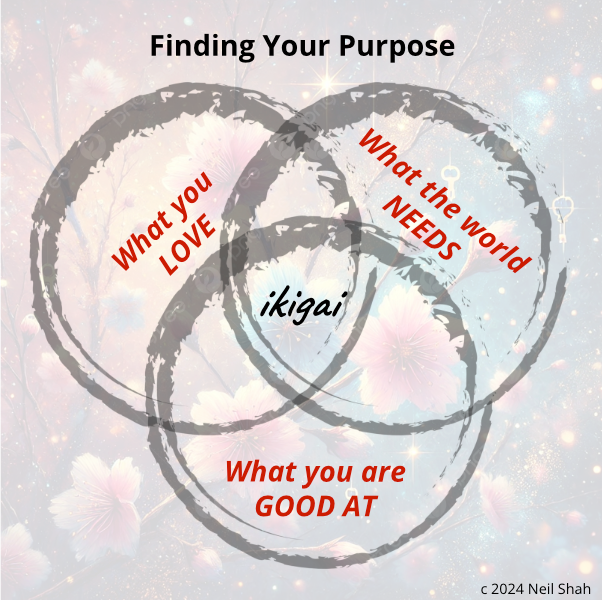
Wait — what about ‘what can I get paid for’? Try to remove it from the equation. Yes, it is challenging to give up big tech compensation, often tied to your identity. If you’re not ready yet:
- Work towards financial independence; live frugally without lifestyle inflation. You won’t look back in 30 years, proud of the experiment you ran increasing the font size that led to x.x% increase in revenue — no one cares.
- Early in your career, you may not have as much choice in what projects or companies you work at but aim towards something bigger. Be conscious of building your skillset to get to a more impactful positioning with your career, to contribute to humanity.
As I explore my own ikigai, I can think of no bigger impact than taking my experiences in tech to see how I might apply it to government. I’ve learned it’s far more meaningful to spend time on the right problem, even if complex, where the juice is worth the squeeze over short term wins. This leverage can create lasting impact, and something we can look back on and say ‘we did that’.
Final advice —
- Be you: explore your curiosity. Instead of getting caught in the rat race with an ever moving goal post I’ve repeatedly explored my interests. It’ll help you find what you’re passionate about.
- Ask yourself: what can you do today to improve the life of one person? Find the balance between (1) short term and long term and (2) what you love and what you’re good at to create your version of doing something for humanity.
/Good luck/