Why bother raising children to speak more than English?
Growing up as a child of immigrants in California, many of my friends are second generation Asian. Most are monolingual and deeply regret not being given the opportunity to learn another language as a child. There had been a misconception that the child should only learn English — it was certainly a different time.
Multilingualism has cultural, cognitive, and social benefits. More than half the world speaks 2+ languages. It’s a unique gift that your children will thank you for one day. Also, it’s fun!
No one says it will be easy though, you need to commit time and energy. Persevering in a particular language requires being quite thoughtful — you’ll need to overcome social self-consciousness and will need to up your vocabulary if your second language is rusty.
Let’s Debunk Some Myths:
- The child will be confused: False, they quickly sort out who can speak what.
- The child won’t learn English: False, they’ll learn it in school anyway.
- The child will have speech delays: False, studies show that children who learn multiple languages (including sign language) are capable of communicating earlier, if not the same.
- The child will just pick it up (hearing a second language from a family member or caregiver): False, it takes dedicated exposure and talking to learn another language. Occasionally hearing it from grandma won’t work.
- The child will learn by watching videos in a second language: False, while this is a great tool to help supplement language acquisition, children need to be actively engaged with other people to learn.
Strategies For the Win:
- Playgroups with other bilingual families — a peer group is very important and increases likelihood of raising multilingual children. As the child is exposed to more people speaking the other language they seem to speak it even more.
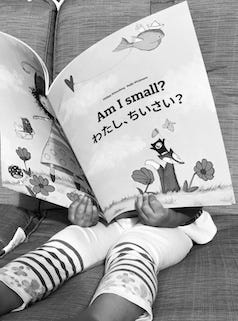
- Story time in the second language. For children who can’t read, you can take any story book and make-up the plot or loosely translate into the second language. Don’t worry — they don’t know the difference and enjoy it just the same!
- Sing a few songs, many times, in your second language. Repetition helps and they’ll quickly learn.
- Games, games and more games. You play with your kids anyway, so why not talk to them in your second language while doing it. Some of these games may even become special so they’ll want to do it in your secret language.
- If you must watch TV (which I’m not a fan of, more on that another time), watch YouTube foreign videos —it’s amazing how many there are. Highly recommend YouTube Red Subscription to avoid ads and background audio mode.
- Grandparents and international travel — if you have this opportunity, embrace it!
- Talk, talk, talk to your child — have conversations even if you don’t think they quite understand. Talk about anything. They’re learning all the time and will pick it up.
- Host international students (through rotary programs, etc).
- Don’t worry too much about writing/reading — there’s research that suggests they can pick it up later. But, learning to speak and understand is something that can most easily be done before the age of 9 (see Language Acquisition Device)
- PRO TIP: Don’t worry if your spouse or family don’t understand when you speak the second language. Either they will quickly tune you out or they may even pick up basic words. Again, it’s a very special superpower that your child will one day appreciate.
- And the big one — if they speak to you in English, politely ignore or ask them to ask you in the other language. If they struggle with vocabulary it’s ok to help but try to get them to repeat — that’s the ONLY way they’ll learn.
How we are raising multilingual children:
I grew up bilingual — speaking Gujarati on long trips to India and hearing my family speaking it while I grew up in America. Over the years I lost deep verbal fluency in Gujarati (use it or lose it!) but traveling back to India I quickly get most of it back. I picked up my third language in college, studying Japanese. It was quite difficult, but immersion and watching television shows really helped advance my ability.
My wife also grew up bilingual in Bengali and English, but she acquired a deeper fluency through more repeated exposure to India (annual trips for 3 months growing up) and the exclusive language in her household despite growing up in America.
When we decided to send our toddler to the local Japanese school in the Bay Area I reinvested in practicing. My wife had committed to speaking to her in Bengali from birth. We keep each other in check, forcing ourselves to speak only in non-English languages. It’s tough not to fallback on our dominant language (especially since English is our common language), but as our daughter has picked up both Bengali and Japanese we are extremely proud of the results. We’ve also both learned quite a bit of the other language, which was an unexpected surprise.
Resources
Disclaimer: We’re no experts — comments and tips are welcome!