What I learned from experimenting and going down the rabbit hole on South Asian health.
Note: I’m not a doctor. None of this is medical advice. The whole point is the opposite: walk into your doctor’s office with sharper questions.
Why I started
A couple of things collided.
I’m in my early 40s, active and eat well. Then, my father — vegetarian and moderately active his entire life — broke into diabetic range. Textbook South Asian type 2 diabetes. It showed up late enough that it looked fine until it wasn’t. I began asking family history questions — heart attacks and diabetes the norm, not outlier events.
A good friend urged us to get our full lipid panel, stuff they normally don’t test for in annual blood tests, to assess ancestry based risks. The results set me down the rabbit hole. I began treating health as any hard problem I’d tackle at work — measure, tune, repeat. Finally, I was exploring a misogi challenge, an extremely difficult challenge of the body and mind.
In the end health levers are not that complicated — track biomarkers, nutrition, strength, cardio and sleep — the real challenge is accountability. But, something that completely reshaped my outlook on my health guidance from most doctors is built on Eurocentric reference ranges, not South Asian evidence. The result, our primary doctors typically don’t talk about our unique risks unless YOU bring them up.
The one idea that changes everything: you have a different baseline
South Asians hit the same cardiometabolic risk at a much lower body weight than the guidelines assume. I began reading the MASALA study, the first longitudinal research in U.S. South Asians to understand what factors lead to heart disease and guide prevention and treatment. In the MASALA/MESA comparison, a South Asian at a BMI of 19.6 carried the same load of metabolic abnormalities that a White adult didn’t reach until BMI 25.
A “normal” BMI isn’t reassurance for us — it’s the range where the disease actually lives.
The mechanism gets called the “thin-fat” phenotype — we can carry a dangerous amount of fat in places the scale and the mirror never show you. The fat you can’t see (around the organs, and especially in the liver) is the one doing the damage. At matched or even lower BMI, South Asians tend to carry more ectopic fat, less lean muscle, and a worse metabolic-hormone profile than the guidelines were built around.
Practical translation — four thresholds that should shift for a South Asian:
- Diabetes screening starts at BMI 23, not 25.
- Keep your waist under 90 cm (35.4 in) if you’re a man, under 80 cm(31.4 in) if you’re a woman — not the ~102 cm / ~88 cm lines drawn for the average. Central fat is where our risk concentrates, so this is critical to track.
- Screen for fatty liver at BMI 23 too, because the liver is the depot that matters for us.
- HbA1c is the weak screen, not the main one. By the time A1c moves, you’re late. Fasting glucose (ideally an OGTT) and — the big one below — fasting insulin catch it far earlier.
Keep those four numbers in your head. What follows is just acting on them.
Pillar 1 — Biomarkers: test what the standard panel skips
A normal lipid panel and a normal A1c are the two results that reassure South Asians the most and mislead us the most. Here’s what I actually get measured, why, and where I landed. You have to ask your doctor to test for these or do an independent lab via Function, Emphirical Health, etc.
The tests you do once, ever
Lp(a) — one draw for life. Lipoprotein(a) is genetic, lifelong, and basically unmovable by diet or exercise. Mine came back at 148 nmol/L (optimal is under 75). High, and it’s not going anywhere.
Honest nuance most blogs skip: within MASALA’s own data, Lp(a) isn’t dramatically higher in South Asians than in White Americans. So why test it? Because broader evidence (INTERHEART) puts it elevated in a meaningful chunk of South Asians, and because if yours is high, it recalibrates your entire risk picture for the rest of your life. You can’t lower Lp(a) — so instead you drive everything else to the floor: LDL, ApoB, blood pressure, inflammation, glucose. It’s also inherited (roughly 50/50 odds in a first-degree relative), so one test quietly informs your kids and siblings too.
ApoB — the number that should replace “LDL” in your head. LDL-C measures cholesterol mass. ApoB counts the actual artery-clogging particles — and it can run high even when your LDL “looks fine.” Target under 80 if you’re high-risk, under 65 if very-high-risk. This is the real steering wheel.
A CAC scan sometime after 40. Coronary artery calcium is a direct look at whether plaque has actually formed.
The early-warning test nobody orders
Fasting insulin + HOMA-IR. If I could hand a South Asian friend exactly one test, it’s this one.
Insulin resistance shows up years before glucose or A1c budge. The pancreas quietly cranks out more and more insulin to keep your glucose looking beautiful — and it works, right up until it doesn’t. Standard panels never look at insulin, so the earliest, most fixable signal stays invisible unless you ask for it.
- Fasting insulin over ~10 µIU/mL or HOMA-IR over ~2.5 are the red flags.
- In MASALA, South Asians ran higher HOMA-IR than every other US group in midlife — even at matched everything.
My A1c is 5.2% and my fasting glucose is 82 — both excellent — and I still have fasting insulin queued for my next draw. Precisely because that family history is the “compensated until it isn’t” pattern, and glucose is the lagging indicator. This is the gap I’d close before almost any other.
The rest of the “real” panel
Worth adding to a standard draw: hs-CRP (inflammation), homocysteine (we run higher, partly from vegetarian B12 gaps), remnant cholesterol (it’s free — just Total minus HDL minus LDL), vitamin D (deficiency is near-universal in South Asian women), ferritin + full iron studies, and B12/folate.
My numbers, so the abstractions have a shape
- Lp(a): high and genetic; the thing I build everything else around.
- LDL-C: high and on a low-dose statin — a 60% drop in a month (your mileage may vary; that’s a bigger response than most people get).
- ApoB: moderate pre-statin — rechecking on the statin, target under 70.
- CAC: 0 — no calcified plaque.
- hs-CRP: 0.9 mg/L — low inflammation.
- HbA1c / fasting glucose: 5.2% / 82 — excellent, but both lagging indicators.
- CGM (2 weeks): average ~110, time-in-range basically 100%, low variability — flat and stable, no hidden spikes. (note: cgm data can be high and noisy, blood work better — mostly useful to understand spikes and how your body does during the day/night relatively)
- Fasting insulin / HOMA-IR: not yet tested — the gap I’m closing next.
The story those numbers tell: a genetic risk I can’t erase, aggressively offset by driving LDL, ApoB, and inflammation to the floor — and a metabolic picture that looks pristine today but which I refuse to call “solved” until I’ve seen the insulin number.
One note on gadgets. I wore a two-week CGM (continuous glucose monitor). The verdict: trust the patterns, not the absolute number. Consumer sensors read a little high — my CGM average sat above what my A1c predicts. But the shape is gold: no post-meal spikes, no overnight rise, exercise reliably dropping my glucose. A CGM is a fantastic way to watch your metabolism react to food and training in real time. It is not a substitute for the fasting-insulin lab — because it never measures insulin at all.
One more layer: I ran a targeted annotation against my DNA chip. I took my raw 23andMe data, analyzed it locally, and cross-referenced it against public databases and my own blood work. The genome came back mostly reassuring — but it flagged a few things worth watching, and it stayed quiet about the two risks that actually matter most.
Pillar 2 — Nutrition: for veg South Asians, the enemy is white rice, roti, and sweets
Here’s the funny thing, straight from MASALA: vegetarian South Asians actually did better on insulin resistance, LDL, BMI, and fatty liver than the meat-eaters — and they ate more legumes, not fewer.
So the tired “lentils aren’t real protein” line? Unsupported. The real weakness of the traditional veg plate are the carbs around it — white rice, roti, and sweets. More calories from refined carbohydrate, higher glycemic load, not enough omega-3. All of that is recent history, not tradition. Let’s blame it on the British — famine and cheap rice. British-era milling stripped out bran, pushing the whole grains and millets off our great-grandparents’ plates. Our bodies hoard fat and resist insulin — a survival trait during the famines that turned into a liability the moment food got cheap and refined.
We don’t eat the way our ancestors did, and our metabolism is still calibrated that way. The moves that matter for a vegetarian or vegan South Asian:
- Anchor every meal with protein first. Soy (tofu, tempeh, edamame), pulses, seitan. Then build the carbs around it — not the reverse.
- Shrink the refined-starch pile. Less white rice, more intact whole grains, more pulses on the plate.
- Sequence the meal. Veggies and protein first, starch last, then a 10–15 minute walk. Eating in that order plus the walk are two of the best-evidenced, completely free ways to flatten your glucose response. Do both.
- Dairy isn’t one thing — and this one surprised me. In South Asian women, more total dairy (especially low-fat yogurt) tracked with a smaller waist and less visceral fat. It’s the high-fat dairy — ghee, full-fat — that loads the harmful side. On ghee specifically, there’s no universal answer: a controlled trial found it nudged ApoB up versus olive oil on average, but individual response varies a lot. The grown-up move is to test it on yourself — baseline ApoB, swap one fat for 6–8 weeks, retest.
- Cover the plant-based nutrient gaps on purpose. On a vegan/vegetarian diet the near-guaranteed shortfalls are B12, vitamin D, omega-3 (EPA/DHA from algae — your body barely converts the plant kind), iodine, and sometimes iron and zinc. These aren’t optional. They’re the price of admission for the diet. I take B12, D, and algae omega-3, and I dose them by retesting, not guessing — which is how I went from deficient in 2022 to comfortably in range now.
- Iron, if you’re a woman: pair, don’t just pop. Vitamin C with every lentil, bean, or tofu meal (3–4× the absorption), keep coffee and tea an hour away from iron-rich meals, cook acidic foods in cast iron, soak and sprout your legumes. Supplement only on a confirmed-low ferritin, not on a hunch.
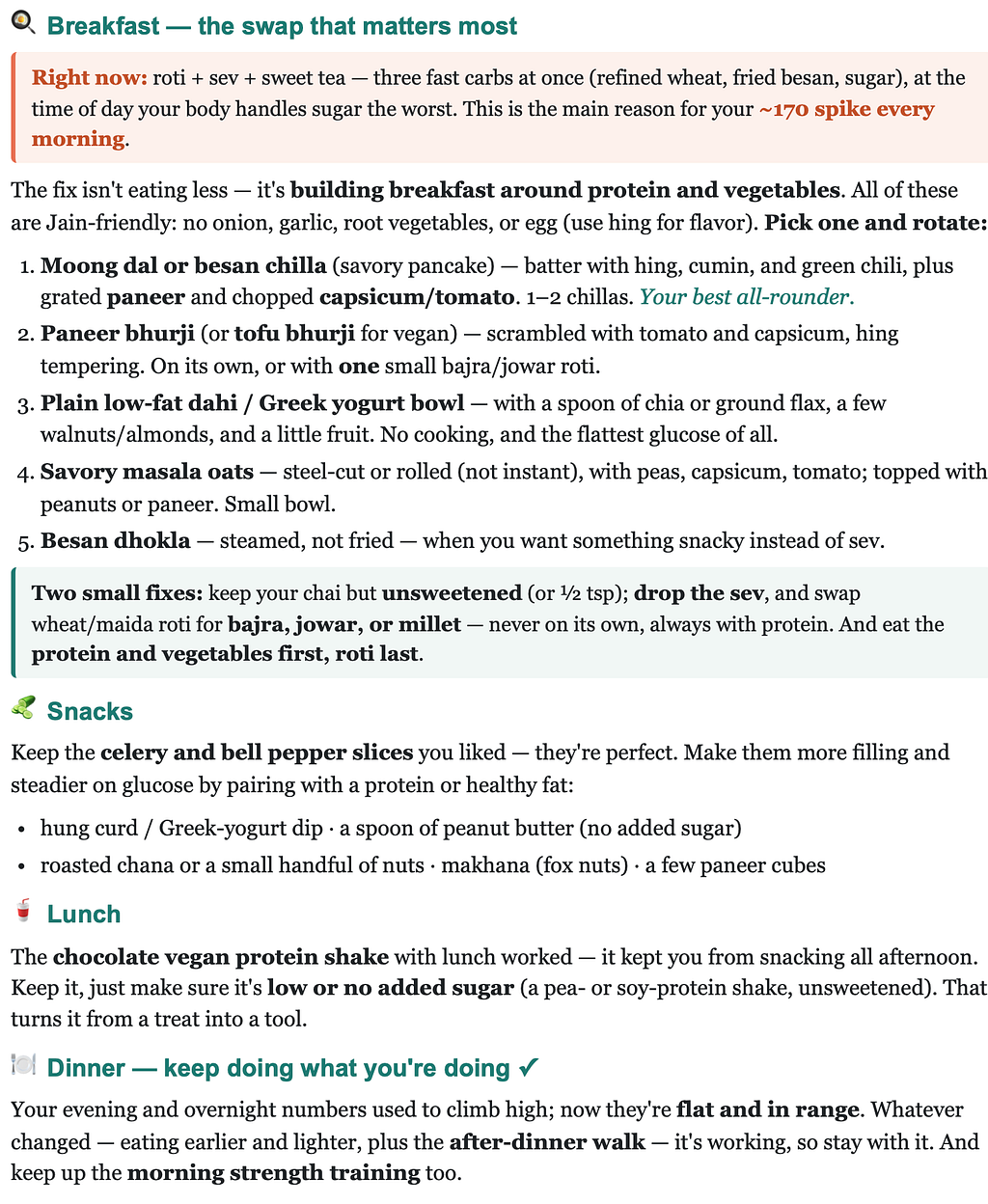
Here’s a plan my AI coach I made for my parents based on their situation:
Pillar 3 — Strength: the metric is your waist, not the scale
My fitness goal isn’t a number on the barbell. It’s recomposition — hold or add muscle while the waist comes down.
For a South Asian, that’s not vanity. Muscle is a glucose sink, and low lean mass is part of our risk phenotype. So I run a simple home program (three full-body days, progressive overload, all sets taken to within 0–2 reps of failure, tracked in Liftosaur), and I track progress with a mix of cheap tools — waist and belly circumference, a daily morning weigh-in, and the occasional DEXA. The one thing I don’t trust is a single day’s bodyweight, because it can’t tell recomposition from stagnation.
The habit that actually moves the needle is boring: weigh yourself every morning, first thing, reading the trend.
Two lessons that took me a while:
- Protein depends on what you’re chasing. If the goal is maxing muscle growth, the best current estimate is ~0.9 g per lb of bodyweight (≈1.1 g/lb of lean mass), with ~0.7 g/lb as the floor and little added benefit past it. But if the goal is metabolic health and holding muscle in a deficit — which, for a South Asian, is the whole point — you don’t need the ceiling; ~0.7 g/lb of goal weight protects muscle just fine. Either way, scale to lean mass, not the scale. That puts me around 140–160 g/day.
- Log to baseline. Take two weeks and pair with a CGM device, use that as your baseline and reference as you keep going.
For a friend starting from zero: two or three full-body sessions a week, basic compound lifts, add a little each week. That single habit does more for South Asian metabolic health than any supplement on the shelf.
Pillar 4 — Cardio: VO₂max is a longevity lever, and I’m using a swim to force it
I split my cardio on purpose, because the zone-training research is clear and I kept muddling it:
- ~80% easy aerobic base (Zone 2) — conversational pace, builds the engine, improves insulin sensitivity. For me it doubles as base training for an open-water goal.
- One hard VO₂max dose a week (4×4-minute intervals) — the session I have to consciously protect, because it’s the easiest one to skip. For my risk profile, a high VO₂max is one of the top longevity levers in the entire literature — not a nice-to-have. I put that dose on the bike, not the swim, because at my swim level my stroke technique gives out before my heart does, so I can’t actually redline in the water. Central fitness transfers across sports — use the tool where you can bury yourself.
The goal that organizes all of it: the Alcatraz crossing — 1.4 miles of open water, this September. This is my Misogi Challlege. I picked it because a concrete, slightly-scary deadline makes the boring aerobic base actually happen.
What training data taught me: the binding constraint was never my pace — that already clears the cutoff. It was continuous time in the water and swimming a straight line against a current. The engine was fine; the gap was somewhere I hadn’t been looking. Very “instrument the real constraint, not the obvious one” — and it applies well beyond swimming.
A goal doesn’t have to be a race. But pick one thing your body has to be able to do — a swim, a hike, carrying your kid up a hill when you’re 60 — and abstract “health” turns into training with a deadline.
Pillar 5 — Sleep: the lever that’s already working, so protect it
I track recovery with a wearable — HRV, resting heart rate, sleep stages. Across a recent month: zero bad-recovery days, resting HR around 51, HRV steady under load. The standout is sleep — about 8.3 hours a night, near-zero sleep debt. And every single low-recovery day traced back to a short night or travel.
That’s the whole lesson: sleep is the foundation. The things that quietly wreck it — late-night eating, alcohol, one short night stacked on a hard day — show up in the data immediately.
I also do daily sauna (strong evidence for cardiovascular and longevity benefit) and cold plunge.
The part that ties it together: a measurement flywheel
None of this works as five separate hobbies. What makes it a system is that the data flows in a loop, and something — increasingly, an AI coach — reads all of it and adjusts next week.
The stack, roughly:
- A Garmin watch captures swims, runs, strength, all-day HRV, sleep, resting HR — and it’s the device workouts sync to. A longtime Apple Watch user, I wanted to go deeper on metrics, so also experimented with Whoop and the Fitbit Air (all work fine).
- Wahoo handles the indoor bike, with workouts pushed straight to it.
- Liftosaur handles strength programming and logging (I shifted to my own customized version of various fitness apps I like).
- A CGM, periodically, shows how food and training move my glucose.
- Tredict is the hub — it ingests the Garmin and Wahoo data, runs the training-load model, and is where structured workouts get written.
- And an AI coach reads everything in the hub, designs the next block, and writes it back to my devices. I can ask questions about nutrition, talk about my workout and get feedback, etc.
The loop: I train → the devices record → the data lands in the hub → the coach reads load, recovery, and zones → it writes next week’s workouts → they push back to my watch and trainer → repeat. Each session sharpens the next decision.
You don’t need any of this to start. And of course there are near infinite variations to manage these metrics. All you need to get started is a wearable and one lab draw. The direction is what matters: close the loop, so decisions come from your data and keep you grounded in the numbers.
Where this goes next: from my system to a family one
If you did only five things this year, I’d pick:
- Get the extended panel once — Lp(a), ApoB, fasting insulin + HOMA-IR, hs-CRP, vitamin D, ferritin, homocysteine.
- Start two strength sessions a week.
- Anchor protein at every meal and walk 10 minutes after.
- Protect 7.5–8 hours of sleep.
- Take the results to a doctor and ask specifically about the South Asian thresholds.
Running this for myself surfaced the obvious next problem — I’m not the only person in my family whose health I care about. Older family members are aging into the classic South Asian cardiometabolic track, and I want to be genuinely involved.
Not “how are you feeling?” involved. “I’ve read your labs and I have three questions for your cardiologist” involved.
Recently my dad joined us on a 10-day road trip. He ate what we ate, I gave him pointers, and he may have been slightly annoyed. At the end he turned to me: “Send me all those recipes. My body feels great, no digestive issues, my glucose is down… I’m shocked.”
Play offense: get the panels, act, repeat.
Read about my personal health toolkit here